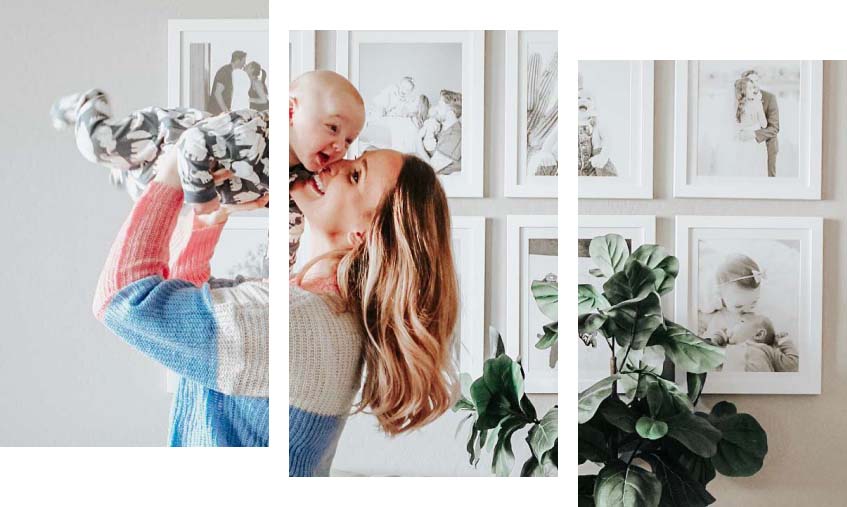
Measuring art correctly is perhaps the most important step in the framing process — if the art size is off, the rest of the measurements for the frame, matting, cover, backing, etc. will also be off, and we don’t want that! *Even if your artwork or the artist claims it to be a certain size, you should always measure it yourself to confirm, just to make sure you receive a frame that fits perfectly.
Learn How to Read a Ruler
Some rulers have an English side– inches, feet, yards, etc.– and a metric side– millimeters, centimeters, meters, etc. The marks on a ruler all have different lengths because they denote different fractional increments.
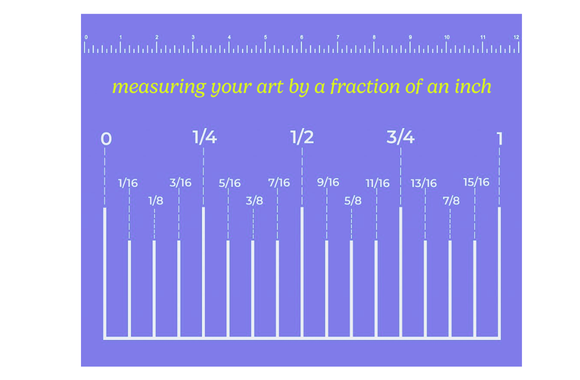
On the English side, the longest ones mark each inch. The second-longest ones mark each half-inch; the third-longest mark each quarter-inch; the fourth-longest mark each eighth of an inch; and the fifth-longest mark each sixteenth of an inch. When lining up the ruler to your art, it’s important to line it up with the nearest fractional increment.
Once again, keep in mind that this measurement will dictate the cut of the frame, backing, and acrylic, so it’s important to make it as precise as possible. Because of this, we strongly advise you use a standard, rigid measuring tape to measure your art, as flexible measuring tapes (such as ones used to measure fabric) may not be entirely accurate for measuring art and photography.
Millimeters (mm) vs. Centimeters (cm) vs. Inches (in)
In some cases, art or photos are measured using millimeters (mm) or centimeters (cm), both part of the metric system (an internationally recognized system of measurement).
1 in = 25.4 mm = 2.54 cm
Always make sure you know which unit of measurement you’re dealing with to make sure the results are accurate.
Here at Frame It Easy we use inches as our standard unit of measurement. For any art that is measured in increments other than inches, you’ll want to make sure you double-check and convert the numbers before entering your measurements into our frame designer.
How to Properly Measure Art
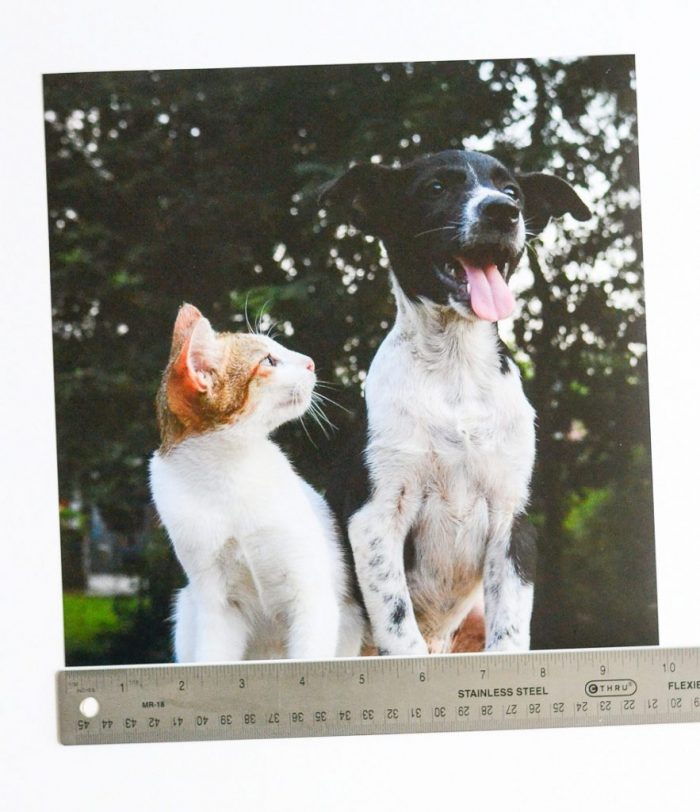
For art you already have, you should start by placing your art in the correct orientation of how you’d like to view it, then measure the width and height of your art, as well as its thickness.
Width = the horizontal measurement from left to right
Height = the vertical measurement from top to bottom
*Thickness = the depth measurement from front to back
*For thickness, you should consider the following: If it’s over 1/4” thick, look for a framer that can create shadow box frames, which are great for wrapped canvas, 3D collectibles, and jerseys.
*For artwork thinner than 1/4”, a standard picture frame will likely suffice, and those are generally the easiest to find.
Here at Frame It Easy we can frame art from 5″x5″ up to 42″x62″. Our metal picture frames have room for artwork up to 1/4″ thick. (This includes matting, so if your frame has a single mat the artwork shouldn’t exceed 3/16″ thick and if it is double matted the artwork shouldn’t exceed 1/8″ thick.)
The spring clips that hold your art into the frame will adjust perfectly as long as your art doesn’t exceed this thickness.
Our wood picture frames have room for artwork up to 1/8″ thick if they have no mats or one mat, and up to 1/16″ if they have two mats.
Art Orientation: Portrait vs. Landscape
Frames come in two main orientations: portrait (vertical) and landscape (horizontal). Portrait frames are taller than they are wide, perfect for vertical compositions, while landscape frames are wider than they are tall, ideal for horizontal artwork and scenic views.
The orientation is dictated by which measurement has the greater value, and the standard format for denoting size is always width first, then height, or WxH. For instance, a frame with the measurements of 8″ X 10″– the first number being “Width” and the second being “Height”, is a portrait.
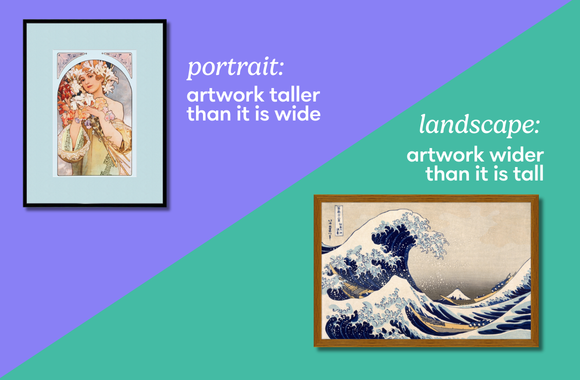
For a frame with the same measurements, but a landscape orientation, you would go with 10″ X 8″, the greater number being assigned to the “Width” measurement.
Your art’s orientation is important as this will affect which direction your hanging wire is placed.
Pro Tip: You can easily orient your frame to landscape with the 3 L’s: To make a Landscape, the Larger dimension is entered on the Left.
Will Any Part Of My Art Be Covered By The Frame?
All picture frames generally require some sort of slight overlap (1/4″) to keep your art held in place. This is referred to as the 1/4″ overlap.
What If My Art Has A Border?
If your art has a border surrounding it that you might not want to be shown in your final frame, you have an option to cover it by adding picture matting. Or if you’re feeling brave, you can trim it yourself. Just measure your art and order your frame after you trim!
Sizing Digital Art
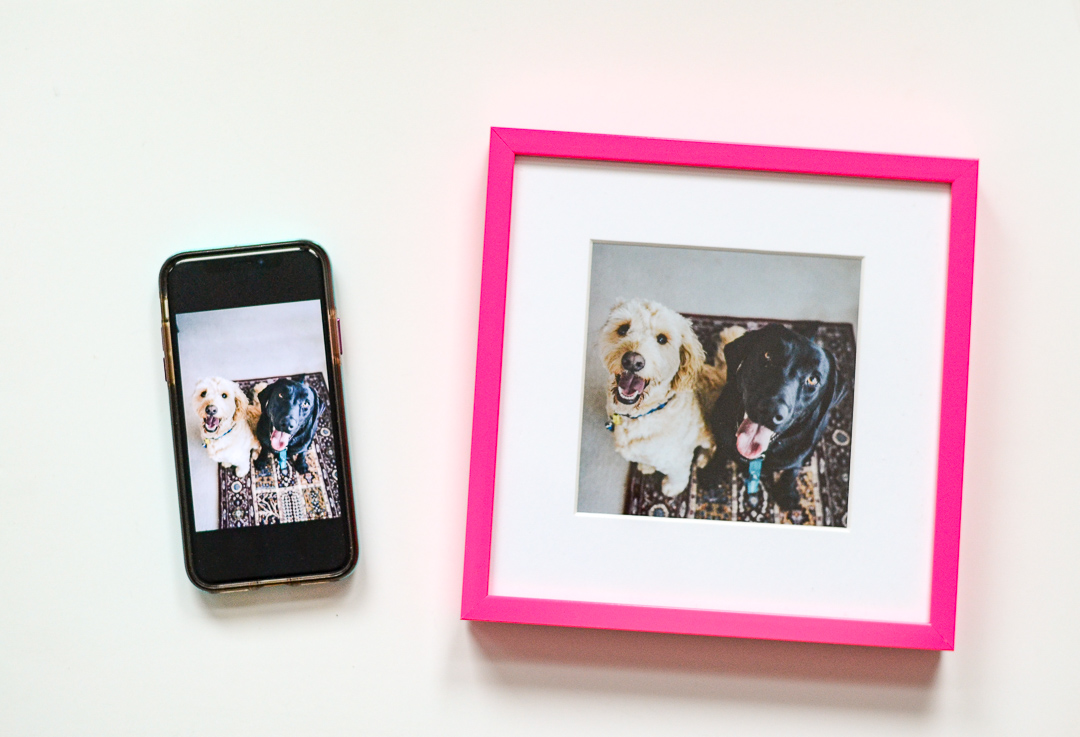
For digital artworks or photographs, you generally won’t have to worry about manually measuring, but there are still some considerations when it comes to sizing.
You can read more about DPI and quality in our post about formatting digital photos, but the most important thing to remember is to always use the highest resolution image possible for the best results.
Print anf Frame Your Art: Here at Frame It Easy we will always print your digitally uploaded photos at the highest possible dots per inch for the size that you select.
However, because it is not possible to add detail to a photo after it is taken, the larger you choose to print your photo the blurrier it will look up close. (Think about stretching a standard 4″ by 6″ photo to fit a billboard – it will look great from a couple of hundred feet away but will look very blurry up close.)
You may also notice that our website won’t let you print a photo larger than a certain size – this is to avoid printing something of very low quality.
Final Thoughts
Measuring your artwork correctly is key to getting the perfect frame. Always check your orientation, width first for landscape, height first for portrait, and account for thickness if your piece is over ¼″, as shadow box frames may be required. Use fractional increments on your ruler for precision, and for digital art, make sure your files are 300+ DPI for the best print quality.
By following these tips, you can confidently determine your art size and frame dimensions, avoiding gaps, misaligned mats, or framing errors. With the right measurements in hand, your artwork will look its best in a frame that fits perfectly, whether it’s a classic print, original painting, concert posters, or custom cross-stitch.
Now that you’ve mastered the measuring basics, you’re ready to bring your art to life in a frame that protects it and showcases it beautifully.

TL;DR: FAQs About Measure Art To Frame
How do I measure my artwork for a frame?
Measure the height and width of your artwork, including any matting you plan to use. If you’re framing fabric or cross-stitch, stretch it over a backing board first, then measure the final dimensions to get your “art size.”
Do I measure the frame or the artwork?
You always measure the artwork itself (plus optional matting). The frame size is based on these measurements, so you can select a frame that fits snugly and looks balanced.
What if my art is irregularly shaped?
For irregularly shaped artwork, measure the widest points horizontally and vertically. You can then choose a frame or mat style that accommodates the unique dimensions. You can always try float mounting.
Do I need to measure the depth or thickness of my art?
Yes! Some frames, especially wood, have a maximum depth. If your artwork, canvas, or mounted piece is thicker than the frame can hold, you may need a deeper frame or to use spacers.
Can I measure framed art I already own?
Yes, measure from inside edge to inside edge to get the size of the artwork itself. This helps you choose a new frame or replicate the look with new pieces.
What tools do I need to measure my art accurately?
A ruler or measuring tape works well. For precision, use a flat surface and measure straight across, making note of both height and width. Consider a level if you’re planning a gallery wall.
Why is measuring correctly so important?
Accurate measurements ensure your artwork fits the frame perfectly and avoids gaps, bulges, or misaligned mats. It also saves time and prevents returns or refitting.